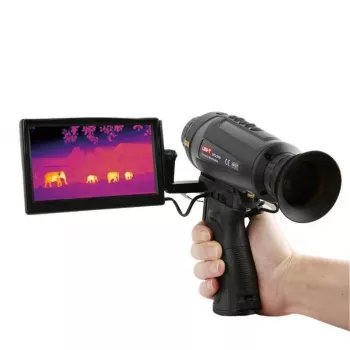
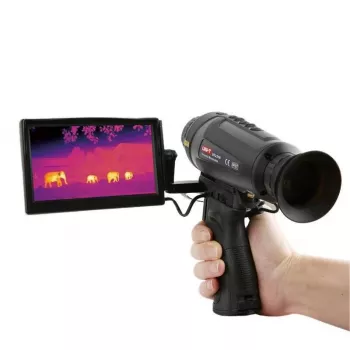
The UNI-T UTx318 offers a different way to take in an outdoor scene. Instead of depending on visible light, a thermal imaging monocular displays infrared radiation as an image, helping you notice temperature contrasts that might otherwise be difficult to spot after dark.
Thermal viewing can add another perspective to wildlife watching and outdoor trips, but it takes practice to interpret what you see. We recommend considering where you plan to use a monocular, how far you expect to look, and which specifications matter for those conditions before you buy.
A conventional camera records visible light reflected from a scene. A thermal imager detects infrared radiation and presents differences in that radiation as an image. Objects and surfaces at different temperatures can stand out from one another, even when there is little or no visible light. For more background on infrared radiation, see NASA Science’s guide to infrared waves.
That contrast can be useful when you are scanning a landscape at night or looking across an area where shapes are difficult to distinguish with your eyes alone. A warmer object may appear distinct from a cooler background, although the appearance depends on the conditions and the display settings.
A thermal image is not a photograph. Fine markings, colors, and familiar visual details may not appear as you expect. A visible contrast can draw your attention to something, but it does not automatically tell you what that object is or whether it is moving toward you.
For wildlife observation, a thermal view can help you scan an open landscape for temperature contrasts without approaching an animal. Once you notice a possible subject, take time to observe its movement and surroundings. Keep a respectful distance, avoid disturbing wildlife, and follow local wildlife and land-access rules.
Around a campsite, you might use a monocular to survey the surrounding area after dark. It can provide another view of the scene, but you should confirm what you are seeing before deciding how to respond. During an excursion, thermal viewing can also be an interesting way to explore how terrain, vegetation, and objects appear at different temperatures.
Keep a flashlight, appropriate navigation tools, communication equipment, and other supplies suited to your trip. A thermal monocular is not a substitute for navigation or safety equipment, and it should not be your only means of assessing hazards.
| Scenario | Potential use | Practical consideration |
|---|---|---|
| Wildlife watching | Scan for temperature contrasts in a landscape | Keep a respectful distance and avoid disturbing animals |
| Campsite observation | Survey the surrounding area after dark | Confirm what you see before acting on it |
| Outdoor excursions | Explore surroundings using a thermal view | Carry appropriate navigation and safety equipment |
Start with your usual viewing distance and setting. Scanning a wide field from a fixed position is different from observing along a wooded trail. Think about whether you need a broad view of your surroundings or expect to spend more time examining distant subjects. Also consider how much equipment you are comfortable carrying and what fits your budget.
Detector resolution affects how much detail a thermal image can display. More detail can help when interpreting a scene, though resolution alone does not guarantee that you can identify an object at a particular distance. Field of view matters too: a wider view can make scanning easier, while a narrower view may be more useful for examining a smaller area.
Battery life is especially important on longer outings or when charging opportunities are limited. Consider the expected runtime alongside the length of your trips and any spare power options. Weather protection matters if you expect rain, damp conditions, or changes in temperature; compare the stated protection with the conditions you actually encounter.
We recommend confirming the UTx318’s specifications and included accessories on the product listing before ordering. If you need help assessing whether it suits your intended use, contact our team.
Scan slowly rather than sweeping rapidly across the landscape. Pause when you notice a contrast and give yourself time to compare it with the surrounding scene. Watching for movement or changes over time can provide useful context, but a heat signature alone does not confirm an object’s identity.
Distance, weather, and temperature differences all affect what you can see. An object may be easier to distinguish when its temperature differs substantially from its background; it may be less distinct when temperatures are similar. Rain, fog, and other conditions can also make a scene harder to interpret.
Practice in a familiar area first. Comparing a thermal view with what you can safely observe in visible light can help you learn how common features appear without treating the display as a complete picture of your surroundings.
If you want a dedicated thermal monocular for outdoor observation, explore our UNI-T UTx318 Thermal Imaging Monocular. Its listed price is $1,915.65, subject to change. Review the product page before purchasing to confirm the details that matter for your trips.
For a separate, non-equipment read, we also carry the Relaxation eBook Guide.
Yes. Thermal imaging detects infrared radiation rather than relying on visible light, although how clearly you can see an object still depends on conditions and temperature contrast.
No. A thermal monocular generally shows the temperature pattern on a wall’s surface, not a view through the wall.
Confirm its specifications and included accessories, and consider whether they suit your intended viewing distance and outdoor conditions. Our team can help with questions before you order.



Leave a comment