-
Shop
- Adidas
- Advanced Technologies
- Bathroom
- Best-Sellers
- Car Accessories
- Dating & Social Skills
- Digital Resources
- AI & Technology
- AI Skills
- Beauty
- Budgeting & Saving
- Car Buying & Ownership
- Cozy Feast Collection
- Electronics & Technology
- Emotional Intelligence
- Entrepreneurship & Business Growth
- Financial Education
- Financial Independence
- Financial Mindset & Psychology
- Goal Setting
- Home Styling & Organization
- Kitchen & Recipes
- Leadership
- Mindfulness
- Mindset
- Motivation
- Online Business
- Parenting & Child Development
- Personal Style & Fashion
- Pet Lifestyle & Wellness
- Positive Thinking
- Productivity
- Self Confidence
- Sleep Improvement
- Smart Life with AI
- Stress Management & Relaxation
- Travel Planning
- Wellness
- Yoga & Fitness
- Yoga & Mind-Body Practices
- Easter Products
- Education & Learning
- Family & Parenting
- Fashion
- Alexander McQueen
- Bags
- Bags & Wallets
- Balenciaga
- Belts
- Blazers
- Bottega Veneta
- Brunello Cucinelli
- Burberry
- Chanel
- Chloé
- Dior
- Dolce & Gabbana
- Dresses
- Etro
- Fendi
- Gucci
- Hats & Hair Accessories
- Jewelry
- Jil Sander
- Keychains
- Kiton
- Luggage
- Miu Miu
- Off-White
- Outerwear
- Prada
- Rick Owens
- Saint Laurent
- Shoes
- Socks & Tights
- The Row
- Tom Ford
- Valentino
- Valentino Garavani
- Versace
- Vivienne Westwood
- Watches
- Furniture
- Gadgets
- Health & Beauty
- Health & Wellness
- Home & Garden
- Home Electronics
- Kids & Babies
- Kitchen
- Lighting
- Patio, Lawn & Garden
- Personal Growth
- Pet Care
- Pet Supplies
- Pets
- Smart Home Living Guides
- Sport & Outdoors
- Stress Relief & Relaxation
- TikTok Growth & Monetization Mastery
- Travel
- Wealth
- Wealth Building
- Popular
- Best deals
Stop Worrying About What You Can’t Control: A Calm Plan

Modern Calm Isn’t Passive—It’s Practiced
Modern life rewards constant attention, yet the mind pays the bill through worry, rumination, and emotional exhaustion. Calm isn’t passive—it’s a practiced skill built by separating what can be influenced from what can’t, then training attention, body, and habits to respond with steadiness. The goal isn’t to “never worry,” but to stop feeding the loop that keeps worry alive. With a few repeatable tools, it’s possible to build a more stable inner baseline even when the outside feels unpredictable.
Why worry sticks: the brain’s “threat scanner” in everyday life
Worry often begins as problem-solving: your mind tries to protect you by anticipating what could go wrong. The trouble starts when predictions keep looping without new information. That loop can feel urgent, but it rarely produces better decisions—only more mental noise.
Uncertainty tends to increase “checking” behaviors: refreshing the news, replaying a conversation, scanning your body for symptoms, or looking for reassurance. Short-term relief teaches the brain that monitoring equals safety, which makes it harder to stop later.
The body adds fuel, too. Stress arousal—tight chest, shallow breathing, stomach tension, insomnia—can be misread as danger. When the body feels keyed up, the mind tries to explain it, often by generating more threat scenarios. Over time, control-seeking behaviors can look productive (“I’m staying on top of things”), yet they reinforce the belief that safety depends on constant vigilance.
The Control Map: separate influence, responsibility, and acceptance
A practical way to weaken worry is to sort it. Use three buckets:
- Control: your actions, choices, routines, and what you say or do.
- Influence: requests, boundaries, collaboration, and how you show up with others.
- Acceptance: other people’s reactions, global events, the past, and outcomes you can’t guarantee.
Try this fast test: “Is there a specific action I can take within 24 hours?” If the answer is no, move it to acceptance for now. Then choose a calming replacement so your nervous system doesn’t keep reactivating the same loop.
Acceptance isn’t approval. It means stopping the internal argument with reality so energy can return to what matters. It also reduces “false responsibility”—the habit of confusing compassion with ownership. Caring about an outcome doesn’t mean controlling it.
Control Map examples: turning worry into a next step
| Worry trigger | What can be controlled | What can be influenced | What must be accepted | One calming replacement |
|---|---|---|---|---|
| Unpredictable news cycle | Limit updates to 2 check-ins/day | Support a cause locally | Uncertain headlines and timing | 5-minute breathing reset + a short walk |
| Other people’s opinions | Speak clearly and kindly | Ask clarifying questions | Their final judgment | Name the fear, then return to values |
| Workload feels endless | Prioritize top 3 tasks | Negotiate deadlines | Not finishing everything today | 10-minute focused sprint + break |
| Health worries | Schedule appointment, follow plan | Seek reliable information | Complete certainty about outcomes | Grounding exercise + sleep routine |
Calm mindset shifts that reduce rumination
Mindset shifts work best when they’re small and specific—something you can repeat in the moment.
- From prediction to presence: replace “What if?” with “What’s true right now, in this moment?” Name three facts you can verify.
- From perfection to sufficiency: choose “good enough for today” to prevent endless mental revising and second-guessing.
- From certainty-seeking to flexibility: practice holding two truths—“This is hard” and “It’s still manageable.”
- From self-criticism to coaching: talk to your mind like a steady mentor would: kind, specific, and action-oriented.
- From control to commitment: decide what matters (health, relationships, integrity) and measure progress by aligned actions, not outcomes.
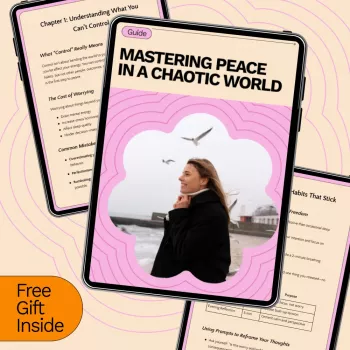
For a structured, step-by-step approach to stopping worry loops, Mastering Peace in a Chaotic World: How to Stop Worrying About Things You Can’t Control focuses on repeatable exercises that turn these shifts into a daily practice.
Nervous-system tools: get the body on your side
When the body is in threat mode, the mind will hunt for threats. Downshifting the nervous system makes it easier to think clearly and let go.
Mindfulness and meditation can be helpful complements for many people; the National Center for Complementary and Integrative Health summarizes evidence and safety considerations here: Meditation and mindfulness (NCCIH).
Emotional boundaries: stop absorbing everyone else’s storm
If stress is chronic, credible education can help normalize the experience and guide next steps. The American Psychological Association’s stress resources are a strong starting point.
A 7-day calm plan for chaotic weeks
Some people also like sensory rituals that cue relaxation. If aromatherapy is appealing, How Essential Oils Can Ease Stress and Anxiety offers a practical guide to using scents as part of a wind-down routine.
When worry becomes too heavy: signs to get extra support
FAQ
How do you stop worrying about things you can’t control?
Use a Control Map (control, influence, accept), take one concrete action in the control bucket, then redirect attention to a calming body-based tool like slow exhale breathing or grounding so the loop doesn’t restart.
Is acceptance the same as giving up?
Acceptance means stopping the fight with reality so energy can return to values and choices. Giving up is withdrawing from meaningful action; acceptance often leads to clearer, more effective action.
What are quick ways to calm down when the mind is spiraling?
Try 2–5 minutes of inhale 4/exhale 6 breathing, the 5-4-3-2-1 senses exercise, or a short walk while naming three facts that are true right now.















Leave a comment