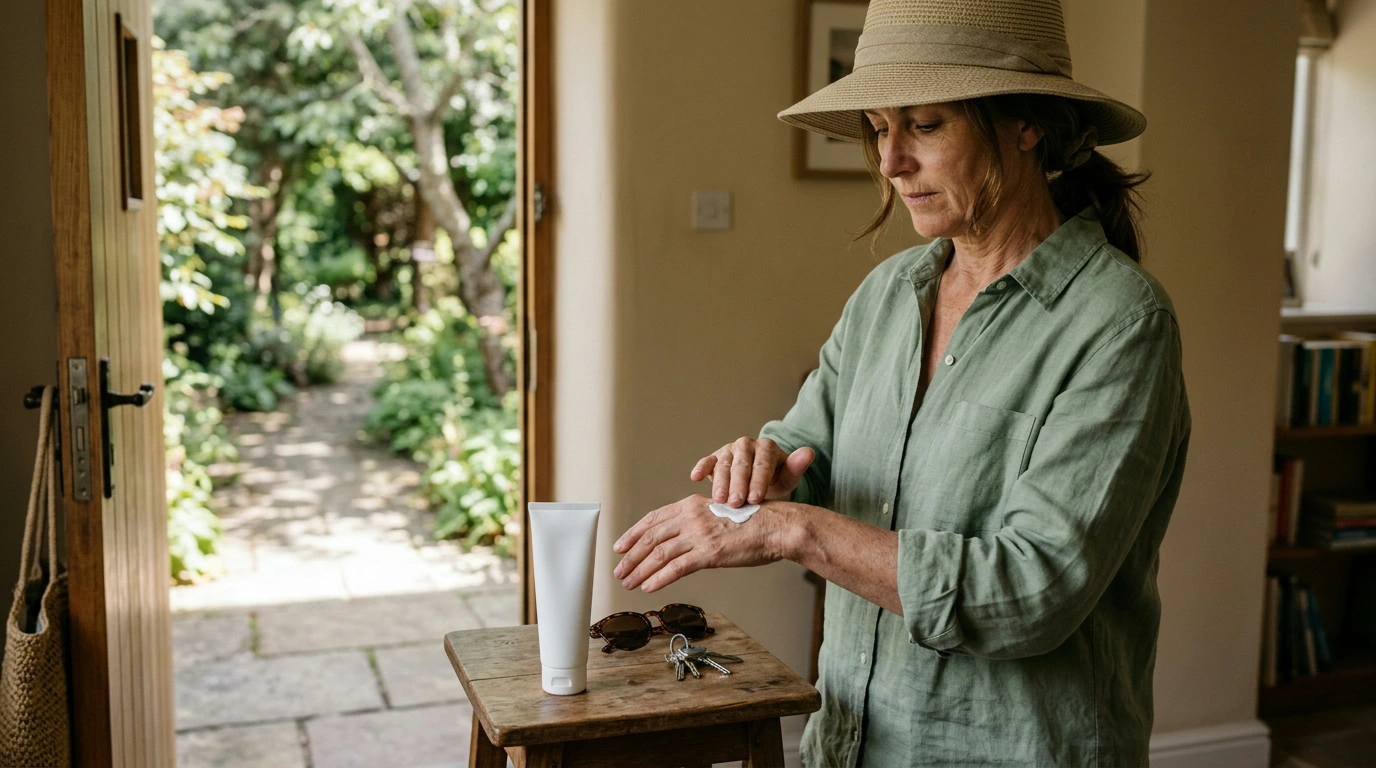
Sun protection can be part of a comfortable daily routine, even when your skin reacts easily. The key is to use several forms of protection, choose products with care, and notice how your skin responds. Our team recommends starting with a few manageable habits rather than relying on sunscreen alone.
Our Sensitive Skin Survival Guide eBook is a convenient resource for anyone interested in daily UV protection and a sun safety checklist.
Ultraviolet (UV) radiation can cause sunburn, premature skin aging, and skin cancer. Anyone can experience sun damage, regardless of skin tone or whether their skin feels sensitive. You may not always notice damage right away, so it helps to protect exposed skin consistently rather than waiting for redness to appear.
Sensitive skin can add another consideration: heat or ingredients in a sunscreen may cause discomfort or irritation. A reaction does not mean you have to give up on sun protection. Shade, clothing, and a different sunscreen formula can help you adjust your approach. If reactions persist, consult a dermatologist for advice tailored to your skin.
Choose a broad-spectrum, water-resistant sunscreen with an SPF of 30 or higher. Broad-spectrum protection helps guard against both UVA and UVB rays. Apply it generously to exposed skin before going outdoors, including on cloudy days. Give yourself enough time to apply it according to the product label before heading out.
Remember areas that are easy to miss, such as your ears, the back of your neck, and the tops of your feet when they are exposed. For your lips, consider a lip balm with SPF 30 or higher. If your clothing leaves a gap at the wrist or neckline, protect that skin too.
If your skin is sensitive, a fragrance-free mineral sunscreen containing zinc oxide or titanium dioxide may be worth trying. These ingredients are options, not a guarantee that a product will suit everyone. Test a new formula on a small area first, and stop using it if irritation develops. A dermatologist can help if you repeatedly react to products.
Reapply sunscreen at least every two hours while outdoors and after swimming or sweating, following the label. Water-resistant does not mean waterproof, so reapplication still matters. Keep your sunscreen somewhere convenient, such as a bag you take on errands, so it is easier to use when plans change.
For more information on choosing and using sunscreen, see the American Academy of Dermatology’s sunscreen FAQs.
Sunscreen works best as one part of your plan. Seek shade when possible and wear protective clothing, a wide-brimmed hat, and UV-blocking sunglasses. These measures can be especially useful if your skin is uncomfortable in the heat or you are trying a new sunscreen.
Take extra care when UV rays are generally strongest, between 10 a.m. and 4 p.m. Water and sand can reflect UV rays, so plan for protection around them even when you are sitting under shade. The CDC’s sun safety guidance offers more ways to reduce exposure.
| Situation | Protection to consider |
|---|---|
| Daily errands | Apply broad-spectrum SPF 30 or higher to exposed skin before heading out. |
| Extended time outdoors | Seek shade, cover up, and reapply sunscreen at least every two hours. |
| Swimming or sweating | Use water-resistant sunscreen and reapply after swimming or sweating. |
| A new sunscreen | Test it on a small area first and stop using it if irritation develops. |
Before you leave, consider how long you will be outside and whether you will have access to shade. Pack a hat and sunscreen for a short outing, and add a cover-up and a plan for reapplication if you expect to stay out longer. A little preparation can make it easier to follow through when you are busy.
Building a routine is often easier when your reminders are close at hand. You can explore our Sensitive Skin Survival Guide eBook for daily UV protection and a sun safety checklist. It is listed at $19.99 USD and is a practical resource to revisit as your outdoor plans change.
If you are also interested in relaxation reading, our essential oils and relaxation eBook is a separate resource. It is not a substitute for sun protection; if your skin is sensitive, use care with fragranced products and discuss persistent reactions with a dermatologist.
Our general sun safety guidance does not replace personalized medical advice. Ask a qualified healthcare professional about persistent irritation, a concerning skin change, or questions specific to your health.
Consider a fragrance-free, broad-spectrum sunscreen with SPF 30 or higher; a mineral formula with zinc oxide or titanium dioxide may be worth trying. Test a small area first and consult a dermatologist if reactions persist.
Yes. UV rays can reach your skin through clouds, so use sun protection when spending time outdoors.
Reapply at least every two hours while outdoors and after swimming or sweating, following the product label.







Leave a comment