-
Shop
- Adidas
- Advanced Technologies
- Bathroom
- Best-Sellers
- Car Accessories
- Dating & Social Skills
- Digital Resources
- AI & Technology
- AI Skills
- Beauty
- Budgeting & Saving
- Car Buying & Ownership
- Cozy Feast Collection
- Electronics & Technology
- Emotional Intelligence
- Entrepreneurship & Business Growth
- Financial Education
- Financial Independence
- Financial Mindset & Psychology
- Goal Setting
- Home Styling & Organization
- Kitchen & Recipes
- Leadership
- Mindfulness
- Mindset
- Motivation
- Online Business
- Parenting & Child Development
- Personal Style & Fashion
- Pet Lifestyle & Wellness
- Positive Thinking
- Productivity
- Self Confidence
- Sleep Improvement
- Smart Life with AI
- Stress Management & Relaxation
- Travel Planning
- Wellness
- Yoga & Fitness
- Yoga & Mind-Body Practices
- Easter Products
- Education & Learning
- Family & Parenting
- Fashion
- Alexander McQueen
- Bags
- Bags & Wallets
- Balenciaga
- Belts
- Blazers
- Bottega Veneta
- Brunello Cucinelli
- Burberry
- Chanel
- Chloé
- Dior
- Dolce & Gabbana
- Dresses
- Etro
- Fendi
- Gucci
- Hats & Hair Accessories
- Jewelry
- Jil Sander
- Keychains
- Kiton
- Luggage
- Miu Miu
- Off-White
- Outerwear
- Prada
- Rick Owens
- Saint Laurent
- Shoes
- Socks & Tights
- The Row
- Tom Ford
- Valentino
- Valentino Garavani
- Versace
- Vivienne Westwood
- Watches
- Furniture
- Gadgets
- Health & Beauty
- Health & Wellness
- Home & Garden
- Home Electronics
- Kids & Babies
- Kitchen
- Lighting
- Patio, Lawn & Garden
- Personal Growth
- Pet Care
- Pet Supplies
- Pets
- Smart Home Living Guides
- Sport & Outdoors
- Stress Relief & Relaxation
- TikTok Growth & Monetization Mastery
- Travel
- Wealth
- Wealth Building
- Popular
- Best deals
How to Get Motivated After Burnout: 5-Step Reset Plan

Recognize what burnout does to motivation
When motivation disappears after a long stretch of stress, it’s rarely a character flaw. Burnout often puts the nervous system into “protection mode,” which can look like procrastination, indecision, or a sudden loss of ambition—when it’s really your body and brain trying to conserve what’s left.
Common signs include exhaustion that doesn’t fully lift with rest, cynicism or irritability, reduced effectiveness, avoidance, and brain fog. If you’re used to being driven, these shifts can be confusing and can easily spiral into self-criticism.
The “just try harder” approach tends to backfire because it adds pressure and reinforces the depletion cycle. A more sustainable frame is capacity first: rebuild energy, then clarity, then momentum. The goal is to create safe wins that re-train your system to trust effort again.
Step 1: Stabilize energy with a “minimum viable day”
Motivation can’t reliably return without baseline energy. For the next 7 days, define a “minimum viable day” that protects recovery even when everything else feels messy.
Pick 3 non-negotiables for one week
- A consistent sleep window (even if it’s not perfect yet).
- Basic meals and hydration (simple foods count).
- One short movement or stretch block (5–15 minutes is enough).
Lower the bar on everything else temporarily. Simplify decisions, reduce optional commitments, and pause new projects that create mental load. If symptoms spike—headache, dread, shutdown—use a recovery rule: switch to maintenance mode instead of forcing output.
Keep tracking lightweight: note bedtime, wake time, caffeine, and one quick energy label (low/medium/high). This is about noticing patterns, not performing.
Step 2: Remove the biggest friction points (without a total life overhaul)
Burnout often persists because life is full of invisible “leaks” that drain energy faster than it can be replenished. You don’t need a dramatic reinvention to improve your day-to-day experience; you need targeted reductions.
Identify your top three drains
- Time sinks (endless meetings, scrolling, errands that sprawl).
- Emotionally heavy tasks (difficult conversations, unresolved conflicts).
- Constant context switching (messages, multitasking, interruptions).
- People-pleasing obligations (events, favors, “just in case” commitments).
Make one reduction per drain
- Shorten meetings by 10–15 minutes or convert one to email.
- Batch messages twice a day instead of checking constantly.
- Set a “no new tasks” cutoff time (for example, after 3 p.m.).
- Decline one optional commitment this week.
Use a soft boundary script—short, calm, repeatable—so you don’t have to re-invent the wording when you’re tired. Example: “I’m at capacity this week. I can’t take that on, but I can revisit it next Monday.”
To rebuild a sense of control, choose one area to simplify right now: your calendar, inbox, chores, or finances. Small order reduces mental friction.
Step 3: Restart motivation with micro-commitments that are hard to fail
After burnout, trying to fix everything at once can trigger the same overwhelm that caused the crash. Instead, pick one meaningful direction—health, career, home, or relationships—and start tiny.
Use a 10-minute starter
Step 4: Rebuild confidence with a weekly momentum loop
Run a simple weekly review
7-Day Motivation Rebuild (Low-Pressure Plan)
| Day | Focus | Small action | Time limit |
|---|---|---|---|
| Day 1 | Stabilize | Set sleep window + drink water on waking | 10 min |
| Day 2 | Reduce friction | Remove or shorten one draining commitment | 15 min |
| Day 3 | Micro-start | 10-minute starter on one meaningful task | 10 min |
| Day 4 | Recover | Gentle movement + early stop if tired | 10–20 min |
| Day 5 | Clarity | Write 3 priorities for next week (no scheduling yet) | 10 min |
| Day 6 | Connection | Reach out to one supportive person | 10 min |
| Day 7 | Review | Note 1 energy gain + choose next micro-step | 10 min |
Step 5: Use supportive tools to stay consistent (without adding pressure)
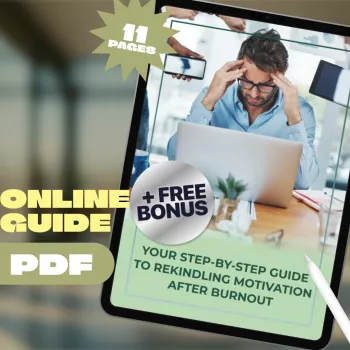
If you want a ready-made structure, consider a guided printable that walks you through the reset steps with minimal friction: Your Step-by-Step Guide to Rekindling Motivation After Burnout – How to Get Motivated After Burnout | Printable PDF Guide.
For additional calming support and a gentle wind-down routine, this guide can help you explore scent-based relaxation habits: How Essential Oils Can Ease Stress and Anxiety | Relaxation eBook Guide for Natural Stress Relief, Aromatherapy, and Anxiety Support.
When to get extra support
Burnout is real and common, and it can overlap with anxiety and depression. The World Health Organization recognizes burnout as an occupational phenomenon linked to chronic workplace stress (WHO overview), and the American Psychological Association offers guidance for coping with work stress (APA resources).
Seek professional support if symptoms last for weeks with no improvement, sleep is severely disrupted, or daily functioning is impaired. Immediate help is important if there are signs of depression, panic, or thoughts of self-harm; the National Institute of Mental Health has an overview of depression and help-seeking steps (NIMH information).
FAQ
How long does it take to feel motivated again after burnout?
It varies, but many people notice improvement over a few weeks to a few months as energy stabilizes first, then clarity, then drive. Recovery tends to move faster when sleep improves, workload is reduced, boundaries are respected, and small actions are repeated consistently.
What if starting anything feels impossible?
Use ultra-small steps (2–10 minutes) and allow maintenance-mode days where the goal is simply to protect sleep, food, hydration, and one tiny task. If the stuck feeling persists or symptoms are severe, getting professional support can help you regain traction safely.
How can motivation return without falling back into overworking?
Keep time caps, stop while it’s still easy, and measure progress by consistency instead of intensity. Weekly reviews and limits like a “no new tasks” cutoff reduce the chance of slipping from momentum into overload.















Leave a comment