
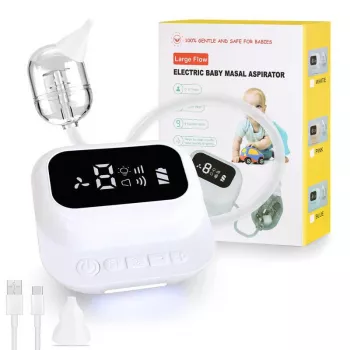
A stuffy nose can make feeding and settling down more challenging for your baby. When mucus needs a little help moving out, an adjustable aspirator gives you an option beyond a single suction setting. Our Electric Baby Nasal Aspirator with 9 Suction Levels lets you adjust the intensity as you care for your little one. For more guidance, see Nursing Research Offers Unique Perspective in Treatments ….
We know that comfort matters as much as convenience. Start gently, follow the product instructions, and pay attention to how your baby responds. An aspirator can help remove nasal mucus, but it is only one part of supportive care. For further reading, see The impact of nasal aspiration with an automatic device … – PMC.
Babies cannot clear their noses the way older children and adults can. When mucus makes it harder for your baby to feed or sleep comfortably, gentle suction may help clear some of it away.
Nine suction levels give you room to adjust instead of relying on one fixed intensity. That does not mean you need to work your way up through the settings. The lowest setting is a sensible place to begin, and you may not need to change it if it removes mucus comfortably.
Follow the product instructions each time you use the aspirator. If your baby appears uncomfortable or the nose becomes irritated, stop. You can ask a healthcare professional for advice about what to do next.
Keep in mind that suction removes mucus; it does not treat the cause of congestion. A stuffy nose can have different causes, and persistent or worsening symptoms deserve medical guidance rather than repeated suctioning.
Think of the settings as options for adjusting your approach, not as a goal to reach. Begin gently, observe your baby, and adjust only if needed. The table below is a general decision guide; it does not describe measured suction strength.
| Situation | Practical approach |
|---|---|
| Getting started | Begin on the lowest setting and follow the product instructions. |
| Mucus remains | Adjust gradually if needed, while watching for discomfort. |
| The nose appears irritated | Stop suctioning and ask a healthcare professional for guidance. |
If mucus remains after a gentle attempt, pause before trying again. More suction is not automatically better, and repeated attempts can irritate delicate nasal tissue. Your baby’s comfort should guide your decision as much as the amount of mucus you see.
Plain saline drops may help loosen mucus before suctioning. Follow the saline product directions and your healthcare professional’s guidance, especially if you are unsure how to use the drops with a young baby. Use plain saline rather than medicated nose drops unless a healthcare professional advises otherwise.
Choose moments when clearing mucus may make a practical difference, such as when congestion interferes with feeding or sleep. Avoid suctioning excessively: even a gentle tool can contribute to irritation when used too often. If you find yourself needing to suction repeatedly, ask your baby’s healthcare professional for individual advice.
Before you begin, read the aspirator’s instructions for positioning and use. Keep your baby supported and follow the directions rather than inserting anything farther than instructed. Stop if your baby shows discomfort, and give yourself time to settle them before deciding whether to continue.
Cleaning is part of the routine, too. Follow the instructions provided with your aspirator for cleaning and care after use. Different devices may have different cleaning requirements, so use the directions for your particular product rather than assuming a method will work for every model.
For more information on caring for a baby with a cold, the American Academy of Pediatrics offers guidance in Your Baby’s First Cold. The FDA also explains important precautions about cough and cold medicines for children.
Contact a healthcare professional if congestion affects feeding, symptoms worsen, or you are concerned about your baby. You do not need to wait for a particular symptom if something about your baby’s condition worries you. For a baby younger than three months, fever warrants prompt medical advice.
Seek urgent medical attention if your baby has difficulty breathing, develops blue or gray skin, or is unusually unresponsive. These signs need immediate attention rather than another attempt at suctioning.
Our Electric Baby Nasal Aspirator with 9 Suction Levels puts adjustable suction at the center of a simple care routine. Start low, make changes gradually only when needed, and stop if your baby seems uncomfortable. The product is listed at $38.97 and is in stock; price and availability may change.
For a separate resource focused on adult relaxation, we also offer How Essential Oils Can Ease Stress and Anxiety | Relaxation eBook Guide for Natural Stress Relief, Aromatherapy, and Anxiety Support. It is not a guide to treating infant congestion; ask a healthcare professional before using any scented products around your baby.
Start at the lowest setting and follow the product instructions. Adjust gradually only if needed, and stop if your baby seems uncomfortable.
Plain saline drops may help loosen mucus before suctioning. Follow the saline product directions and ask a healthcare professional if you are unsure.
Use suction when congestion makes feeding or sleep difficult, and avoid excessive suctioning that can irritate the nose. Ask a healthcare professional for advice tailored to your baby.





Leave a comment