-
Shop
- Adidas
- Advanced Technologies
- Bathroom
- Best-Sellers
- Car Accessories
- Dating & Social Skills
- Digital Resources
- AI & Technology
- AI Skills
- Beauty
- Budgeting & Saving
- Car Buying & Ownership
- Cozy Feast Collection
- Electronics & Technology
- Emotional Intelligence
- Entrepreneurship & Business Growth
- Financial Education
- Financial Independence
- Financial Mindset & Psychology
- Goal Setting
- Home Styling & Organization
- Kitchen & Recipes
- Leadership
- Mindfulness
- Mindset
- Motivation
- Online Business
- Parenting & Child Development
- Personal Style & Fashion
- Pet Lifestyle & Wellness
- Positive Thinking
- Productivity
- Self Confidence
- Sleep Improvement
- Smart Life with AI
- Stress Management & Relaxation
- Travel Planning
- Wellness
- Yoga & Fitness
- Yoga & Mind-Body Practices
- Easter Products
- Education & Learning
- Family & Parenting
- Fashion
- Alexander McQueen
- Bags
- Bags & Wallets
- Balenciaga
- Belts
- Blazers
- Bottega Veneta
- Brunello Cucinelli
- Burberry
- Chanel
- Chloé
- Dior
- Dolce & Gabbana
- Dresses
- Etro
- Fendi
- Gucci
- Hats & Hair Accessories
- Jewelry
- Jil Sander
- Keychains
- Kiton
- Luggage
- Miu Miu
- Off-White
- Outerwear
- Prada
- Rick Owens
- Saint Laurent
- Shoes
- Socks & Tights
- The Row
- Tom Ford
- Valentino
- Valentino Garavani
- Versace
- Vivienne Westwood
- Watches
- Furniture
- Gadgets
- Health & Beauty
- Health & Wellness
- Home & Garden
- Home Electronics
- Kids & Babies
- Kitchen
- Lighting
- Patio, Lawn & Garden
- Personal Growth
- Pet Care
- Pet Supplies
- Pets
- Smart Home Living Guides
- Sport & Outdoors
- Stress Relief & Relaxation
- TikTok Growth & Monetization Mastery
- Travel
- Wealth
- Wealth Building
- Popular
- Best deals
AI About Me Page Checklist: Write a Bio That Sounds Like You
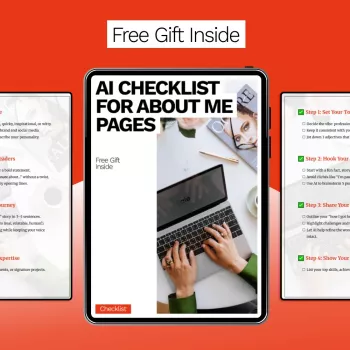
AI Checklist for About Me Pages: A Smart Guide to Writing a Personal Bio That Sounds Like You
A strong About Me page builds trust fast: it tells visitors who the person behind the work is, what they do, who they help, and why they’re credible—without reading like a resume. The best pages are clear on the first screen, specific without bragging, and human without oversharing. Below is a practical, checklist-style way to shape your story and use AI for clarity and flow while keeping every detail accurate and unmistakably yours.
What an effective About Me page needs to accomplish
Most visitors arrive with silent questions: “Who is this?”, “Can they help me?”, and “Can I trust them?” Your job is to answer all three quickly—starting in the first screen—then build confidence with proof, specificity, and a clear next step.
- Make the value obvious immediately: what you do, who it’s for, and the outcome you deliver.
- Provide proof without puffery: experience, results, credentials, recognizable clients, or media mentions—only what you can stand behind.
- Create connection with selective personal detail: motivations, approach, values, and a few human specifics that fit your brand.
- Reduce friction: simple navigation and one clear call to action so visitors don’t wonder what to do next.
Core building blocks for a high-trust About Me page
| Page element | What it should include | Common mistake to avoid |
|---|---|---|
| Opening headline | Who you help + the outcome + your role | Starting with a vague mission statement |
| Short intro paragraph | One-sentence summary + credibility cue + tone | Long life story before value is clear |
| Your story (brief) | Turning points, why you care, what you learned | Oversharing or irrelevant details |
| Proof section | Metrics, testimonials, logos, credentials, awards | Unverifiable claims or inflated results |
| How you work | Your process, principles, what it’s like to collaborate | Buzzwords without specifics |
| Personal touch | A few memorable details that fit your brand | Random facts that distract from the offer |
| Call to action | One primary next step + optional secondary | Too many CTAs or no CTA at all |
Where AI helps most (and where it can hurt)
AI can be excellent at restructuring messy notes, tightening wording, and offering multiple options for headlines and transitions. Where it can hurt is the part that matters most: trust.
- Best uses: brainstorming structure, improving flow, generating alternative headlines, simplifying long sentences.
- Risk areas: factual errors (dates, titles, credentials), generic “corporate” voice, and overpolished language that feels slippery.
- Use constraints: define the audience, tone, reading level, and what to avoid (jargon, hype, exaggeration).
- Reality-check every claim: if you can’t back it up with a portfolio link, testimonial, case study, or straightforward evidence, rewrite it.
For usability expectations and what visitors look for on About pages, Nielsen Norman Group’s research is a helpful reference: About Us Information on Websites.
Checklist-first method: gather inputs before writing
The fastest way to write a believable bio is to collect the raw material first. Think of it as building a small “truth file” you can reuse later.
- Define the reader: client, employer, collaborator—what do they want to feel after reading (relief, confidence, clarity)?
- List offers and outcomes: services/products, problems you solve, and realistic results you’ve delivered.
- Collect proof: 3–5 credibility signals (years, credentials, publications, outcomes, client types, awards).
- Pick your voice: choose 3 adjectives (e.g., warm, direct, practical) to guide edits.
- Choose one conversion goal: book, buy, subscribe, browse, or contact.
A practical About Me page framework (that stays flexible)
A clean structure keeps visitors oriented—and keeps you from dumping everything you’ve ever done into one scrolling monologue.
How to use AI without losing your voice
Quality and trust checks before publishing
- Accuracy: verify dates, titles, credentials, client claims, metrics, and locations.
- Clarity: the first 100 words should explain what you do and who it’s for.
- Specificity: swap “passionate about helping” for a real audience and real outcome.
- Consistency: match tone with your homepage, services, portfolio, and emails.
- Accessibility: scannable headings, short paragraphs, and descriptive link text.
- Compliance: if you use endorsements or results, keep them truthful and not misleading; the FTC guidance is a solid baseline: Endorsements and Testimonials.
If you want a north star for “helpful, people-first” content quality, Google’s guidance on creating helpful content is worth reviewing: Google Search guidance on helpful content.
Digital checklist download: what it helps you finish faster
- AI Checklist for About Me Pages (digital download) — a step-by-step system to plan, draft, and refine an About Me page without missing key trust elements.
- How Essential Oils Can Ease Stress and Anxiety (eBook) — useful when you want a calmer writing routine and a simple reset between edits.
- Turn an Old Car Into a Smart Tax Move (checklist) — a practical, checklist-style guide that’s handy if you’re organizing life/admin tasks while polishing your site.
FAQ
Can an About Me page be written with AI and still feel personal?
Yes—when AI is used for structure and rewriting, but your raw facts, stories, boundaries, and examples come from real notes. The more specific your details and proof are, the more human the final page feels.
How long should an About Me page be?
Most land between 400 and 1,000 words depending on the audience and how much proof you need to include. Keep the opening tight, make the page scannable, and add detail only when it increases trust or removes doubt.
What should be included on an About Me page for freelancers or consultants?
Clear positioning, services/outcomes, a brief story, your process, proof (case studies/testimonials), and one strong call to action such as booking or an inquiry. Add one small human detail to improve memorability without distracting from the offer.
Recommended for you


Bistro Sets: When They’re Worth the Investment
Aug 11, 2026













Leave a comment