-
Shop
- Adidas
- Advanced Technologies
- Bathroom
- Best-Sellers
- Car Accessories
- Dating & Social Skills
- Digital Resources
- AI & Technology
- AI Skills
- Beauty
- Budgeting & Saving
- Car Buying & Ownership
- Cozy Feast Collection
- Electronics & Technology
- Emotional Intelligence
- Entrepreneurship & Business Growth
- Financial Education
- Financial Independence
- Financial Mindset & Psychology
- Goal Setting
- Home Styling & Organization
- Kitchen & Recipes
- Leadership
- Mindfulness
- Mindset
- Motivation
- Online Business
- Parenting & Child Development
- Personal Style & Fashion
- Pet Lifestyle & Wellness
- Positive Thinking
- Productivity
- Self Confidence
- Sleep Improvement
- Smart Life with AI
- Stress Management & Relaxation
- Travel Planning
- Wellness
- Yoga & Fitness
- Yoga & Mind-Body Practices
- Easter Products
- Education & Learning
- Family & Parenting
- Fashion
- Alexander McQueen
- Bags
- Bags & Wallets
- Balenciaga
- Belts
- Blazers
- Bottega Veneta
- Brunello Cucinelli
- Burberry
- Chanel
- Chloé
- Dior
- Dolce & Gabbana
- Dresses
- Etro
- Fendi
- Gucci
- Hats & Hair Accessories
- Jewelry
- Jil Sander
- Keychains
- Kiton
- Luggage
- Miu Miu
- Off-White
- Outerwear
- Prada
- Rick Owens
- Saint Laurent
- Shoes
- Socks & Tights
- The Row
- Tom Ford
- Valentino
- Valentino Garavani
- Versace
- Vivienne Westwood
- Watches
- Furniture
- Gadgets
- Health & Beauty
- Health & Wellness
- Home & Garden
- Home Electronics
- Kids & Babies
- Kitchen
- Lighting
- Patio, Lawn & Garden
- Personal Growth
- Pet Care
- Pet Supplies
- Pets
- Smart Home Living Guides
- Sport & Outdoors
- Stress Relief & Relaxation
- TikTok Growth & Monetization Mastery
- Travel
- Wealth
- Wealth Building
- Popular
- Best deals
Quiet Confidence: Calm Habits for Unshakable Self-Trust

Quiet Confidence: Calm, Certain, Unshakable
Quiet confidence is the ability to feel steady and self-assured without needing to prove anything. It shows up as calm choices, clear boundaries, and consistent follow-through—especially when pressure is high. Instead of chasing approval, quiet confidence relies on self-trust: the sense that you can handle what happens next, even if the outcome isn’t perfect.
The best part is that quiet confidence isn’t a personality trait you either “have” or don’t. It’s built through repeatable habits—small, unglamorous actions that compound into a grounded presence over time.
What Quiet Confidence Looks Like in Real Life
- Staying composed during criticism without becoming defensive or shutting down.
- Speaking with clarity and brevity, even when others are loud or performative.
- Making decisions based on values and evidence, not approval-seeking.
- Allowing silence, pauses, and “I’ll get back to you” without anxiety.
- Owning mistakes quickly and moving to solutions without self-attack.
Notice how none of these require dominance, perfect eloquence, or constant certainty. The signal is steadiness: a calm “center” that doesn’t swing wildly with praise, criticism, or social comparison.
Loud Confidence vs Quiet Confidence
Loud confidence often relies on external signals (status, dominance, constant certainty) while quiet confidence relies on internal stability (self-trust, boundaries, competence). Quiet confidence can feel understated because it doesn’t chase validation; it earns credibility through consistency. When stressed, loud confidence may escalate; quiet confidence tends to slow down and choose the next best step.
Common Differences
| Situation | Loud confidence tends to… | Quiet confidence tends to… |
|---|---|---|
| Receiving feedback | Argue, justify, or perform certainty | Ask clarifying questions and decide what to use |
| Group discussions | Talk more to maintain presence | Talk when it adds value; listen for what matters |
| Uncertainty | Bluff or overpromise | Name assumptions, plan, and follow through |
| Conflict | Escalate to win | De-escalate, set boundaries, and aim for resolution |
| Personal goals | Chase quick proof | Build skills quietly and track progress |
Why Confidence Breaks Under Pressure
- Over-identifying with outcomes: tying self-worth to wins, praise, or perfect performance.
- Threat sensitivity: interpreting neutral cues as rejection or disrespect.
- Skill gaps: insecurity often signals an area that needs practice, not punishment.
- Avoidance loops: avoiding discomfort shrinks confidence; facing it expands capacity.
- Unclear boundaries: saying yes too often leads to resentment and self-doubt.
Stress is a major amplifier here. When your system is chronically activated, it becomes harder to access perspective, choose language carefully, and tolerate uncertainty. The American Psychological Association outlines how stress affects the body and decision-making over time, which helps explain why “just be confident” rarely works without regulation and recovery (APA: Stress effects on the body).
Foundations: Calm Nervous System, Clear Identity, Solid Skills
- Calm: regulate stress so decisions aren’t hijacked by panic, anger, or people-pleasing.
- Identity: define values and standards (what is acceptable, what is non-negotiable).
- Skills: build competence through repetition; confidence follows evidence of capability.
- Integrity: do what was promised, even in small things—self-trust is built on kept commitments.
- Environment: reduce constant comparison triggers; curate inputs that support focus.
If anxiety is part of the picture, it helps to understand it as a pattern your nervous system learned—one that can be retrained. For a clinical overview, the National Institute of Mental Health provides a clear, accessible starting point (NIMH: Anxiety disorders).
Daily Practices That Build Quiet Confidence
- The 2-minute reset: slow breathing (longer exhale) + relax jaw/shoulders + name the next action.
- Micro-promises: commit to one small task daily and finish it; track streaks to build self-trust.
- Evidence list: write 3 examples per week of competence, courage, or follow-through to counter biased self-criticism.
- Boundary script practice: rehearse simple lines (“That doesn’t work for me.” “I can do X, not Y.”) to reduce freeze responses.
- Skill reps: choose one confidence-relevant skill (communication, fitness, negotiation) and schedule deliberate practice.
- Social calibration: aim for warm, direct, and brief—less explaining, more clarity.
- Recovery as discipline: sleep, movement, and nutrition stabilize mood and perceived self-efficacy.
For breathing and relaxation methods that reliably downshift the stress response, Harvard Health offers a practical overview of techniques and why breath control helps (Harvard Health: Relaxation techniques).
Quiet Confidence in Conversations and Work
- Use pauses: answering after a short pause signals thoughtfulness and reduces reactive speech.
- Ask better questions: shift from proving to understanding; questions create authority without aggression.
- Disagree without drama: state the point, the reason, and a proposed alternative.
- Detach from immediate approval: focus on usefulness and clarity rather than being liked in the moment.
- Prepare a “calm certainty” structure: headline (one sentence) → rationale (one reason) → next step (one action).
Try this simple template when a conversation gets tense: “Here’s what I’m seeing (headline). The reason is (one supporting fact). The next step I recommend is (one action).” It keeps you out of spirals, and it makes your communication feel grounded rather than performative.
A Guided Path for Building Calm, Certain, Unshakable Confidence
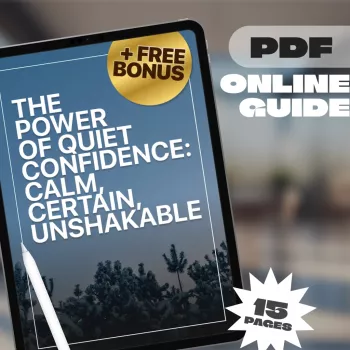
- The Power of Quiet Confidence: Calm, Certain, Unshakable (digital guide) for a step-by-step sequence of exercises and prompts.
- How Essential Oils Can Ease Stress and Anxiety (relaxation eBook guide) to support wind-down routines and recovery practices that stabilize mood.
- Elegant French Burgundy Velvet Long-Sleeve Banquet Dress for Autumn for moments when feeling put-together externally helps reinforce a calm, intentional presence.
FAQ
Can quiet confidence be learned if anxiety is strong?
Yes. Start with nervous system regulation and gradual exposure to small discomforts; confidence grows from repeated evidence that you can cope and follow through.
How long does it take to build quiet confidence?
Noticeable shifts can happen in weeks with daily micro-practices. Deeper stability typically develops over months as skills, boundaries, and self-trust compound.
Is quiet confidence the same as being introverted?
No. Introversion relates to energy preferences, while quiet confidence is a steady internal stance that can be present in both introverts and extroverts.
Recommended for you


Pet Emergency Fund Plan: Costs, Checklist, and Setup
Jul 21, 2026
Best Makeup Brush for Highlighter: Tapered vs Fan
Jul 21, 2026













Leave a comment