-
Shop
- Adidas
- Advanced Technologies
- Bathroom
- Best-Sellers
- Car Accessories
- Dating & Social Skills
- Digital Resources
- AI & Technology
- AI Skills
- Beauty
- Budgeting & Saving
- Car Buying & Ownership
- Cozy Feast Collection
- Electronics & Technology
- Emotional Intelligence
- Entrepreneurship & Business Growth
- Financial Education
- Financial Independence
- Financial Mindset & Psychology
- Goal Setting
- Home Styling & Organization
- Kitchen & Recipes
- Leadership
- Mindfulness
- Mindset
- Motivation
- Online Business
- Parenting & Child Development
- Personal Style & Fashion
- Pet Lifestyle & Wellness
- Positive Thinking
- Productivity
- Self Confidence
- Sleep Improvement
- Smart Life with AI
- Stress Management & Relaxation
- Travel Planning
- Wellness
- Yoga & Fitness
- Yoga & Mind-Body Practices
- Easter Products
- Education & Learning
- Family & Parenting
- Fashion
- Alexander McQueen
- Bags
- Bags & Wallets
- Balenciaga
- Belts
- Blazers
- Bottega Veneta
- Brunello Cucinelli
- Burberry
- Chanel
- Chloé
- Dior
- Dolce & Gabbana
- Dresses
- Etro
- Fendi
- Gucci
- Hats & Hair Accessories
- Jewelry
- Jil Sander
- Keychains
- Kiton
- Luggage
- Miu Miu
- Off-White
- Outerwear
- Prada
- Rick Owens
- Saint Laurent
- Shoes
- Socks & Tights
- The Row
- Tom Ford
- Valentino
- Valentino Garavani
- Versace
- Vivienne Westwood
- Watches
- Furniture
- Gadgets
- Health & Beauty
- Health & Wellness
- Home & Garden
- Home Electronics
- Kids & Babies
- Kitchen
- Lighting
- Patio, Lawn & Garden
- Personal Growth
- Pet Care
- Pet Supplies
- Pets
- Smart Home Living Guides
- Sport & Outdoors
- Stress Relief & Relaxation
- TikTok Growth & Monetization Mastery
- Travel
- Wealth
- Wealth Building
- Popular
- Best deals
Kitchen Mood Makeover Checklist: Quick, Cozy Shifts
Kitchen Mood Makeover Checklist: Small Changes That Shift the Feel of Your Space
A kitchen’s mood is built from dozens of small signals—light color, counter clarity, soft textures, even the way the room sounds when cabinets close. The good news: you don’t need a renovation to make your kitchen feel calmer, cozier, brighter, or more “ready for company.” A simple checklist helps you choose quick, low-lift updates that match the feeling you want and apply them in a sensible order, so each change actually reads as intentional.
Decide the mood before changing anything
Before buying a new towel or swapping a bulb, pick the destination. A kitchen that tries to be “rustic farmhouse,” “minimalist modern,” and “party-ready glam” at the same time often feels visually noisy—even if everything is nice on its own.
- Pick one primary mood (calm, cozy, bright, lively, minimalist, rustic) to avoid mixed signals.
- Choose 3 mood words and keep them visible while you edit (example: warm, clean, inviting).
- Spot the mood-breakers: harsh lighting, visual clutter, mismatched metals, stale odors, or loud appliance noise.
If you’re stuck, walk into the kitchen at night with only the main overhead light on. Whatever feels “off” in that moment is usually your highest-impact fix.
Fast reset: the 15-minute baseline tidy
Even the best styling choices won’t land if the baseline is chaotic. This is the quickest way to reset the room so your mood upgrades look deliberate instead of layered on top of clutter.
- Clear countertops of non-essentials; group what stays into purposeful clusters (a coffee zone, a cooking zone).
- Wipe high-impact surfaces: sink, faucet, stove front, and one main counter run.
- Swap or wash visible textiles: dish towel, hand towel, and any washable mat.
- Remove anything “expired-looking”: wilted flowers, old mail, empty packaging, half-used bottles.
This step is also your “before” snapshot—once the visual noise is down, it’s easier to tell whether your kitchen needs warmth, brightness, or calm.
Lighting changes that shift mood instantly
Lighting is the fastest mood lever because it affects everything else: color accuracy, perceived cleanliness, and even how crowded counters feel. For lighting basics and efficiency considerations, ENERGY STAR’s overview is a helpful reference: ENERGY STAR — Light Bulbs. For a deeper understanding of layered lighting, see: American Lighting Association — Lighting Fundamentals.
- Replace bulbs for consistency across fixtures to reduce visual tension (mixed color temperatures can make a kitchen feel “off” even when it’s tidy).
- Add layered light: task (under-cabinet), ambient (ceiling), and accent (a small lamp or LED strip).
- Match the tone to the mood: warmer light for cozy evenings; neutral light for a clean, energized daytime feel.
- Soften glare with diffused bulbs or a shade/cover when the room feels harsh or clinical.
| Change | Best for | What it fixes |
|---|---|---|
| Warm LED (around 2700K) | Cozy, relaxed evenings | Cold/clinical feel |
| Neutral LED (around 3000–3500K) | Balanced everyday mood | Yellow cast or overly warm look |
| Under-cabinet task lighting | Cooking prep and “clean” vibe | Shadowy counters |
| Dimmer or smart plug | Flexible mood shifts | One-speed lighting that feels harsh |
Color and materials: small edits with big impact
Once lighting is sorted, color and material choices start to look “right” instead of random. The goal isn’t to redecorate—just to repeat a few signals so the room reads cohesive.
- Pick one accent color family and repeat it 2–3 times (textiles, a bowl, a small art print) to create flow.
- Choose materials that support the mood: warm woods, rattan, and brass feel comforting; glass, white, and chrome feel bright and crisp.
- Lighten heavy spaces by reducing dark visual blocks on counters and open shelves.
- Soften sterile spaces with one texture: a linen towel, woven basket, or cushioned mat.
A practical rule: if an item is both visible and used daily, it’s worth choosing one that fits your mood words (soap dispenser, towel, fruit bowl, canister).
Scent and sound: the “invisible” mood levers
If the kitchen looks good but still feels “off,” it’s often air and noise. Ventilation is the first move; the EPA’s indoor air quality guidance is a strong starting point: EPA — Indoor Air Quality.
Styling checkpoints that keep the kitchen functional
Use a printable checklist to make changes in the right order
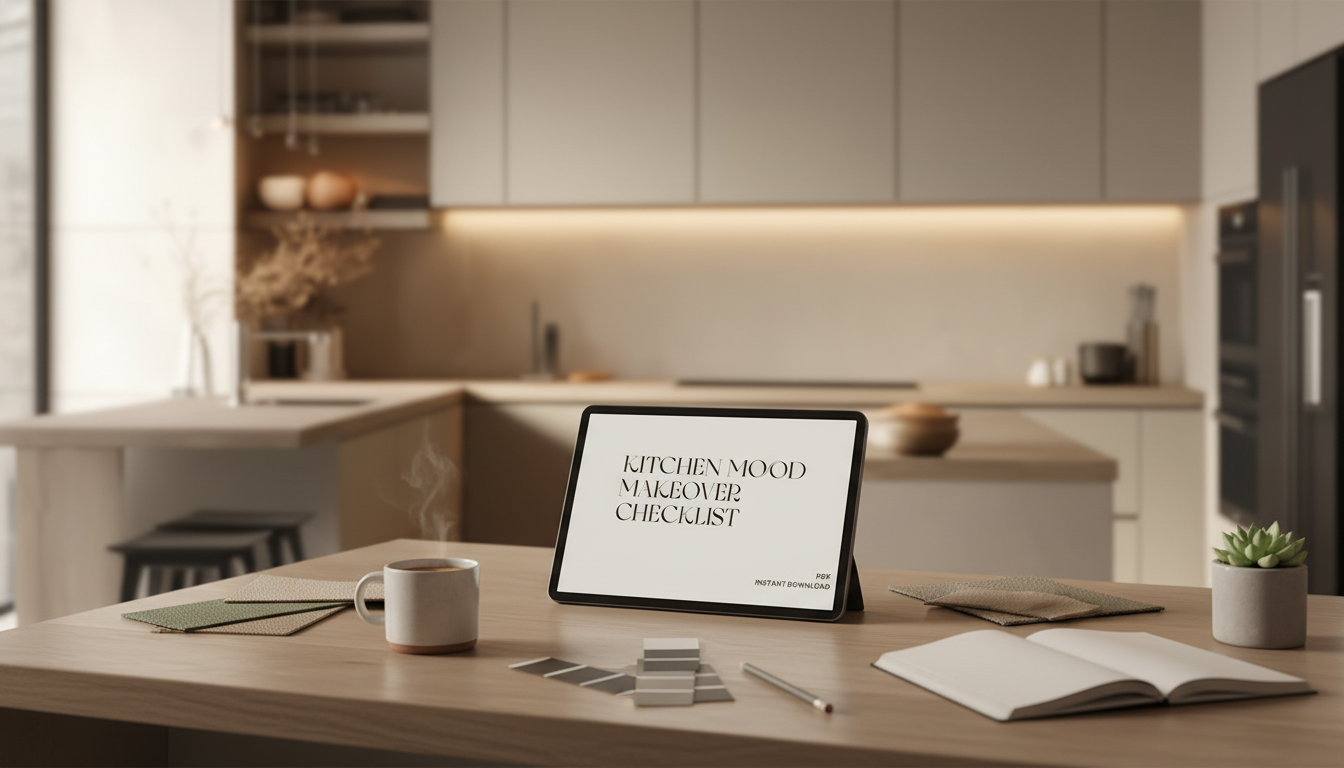
If you want a ready-to-use format, the Kitchen Mood Makeover Checklist (digital download) is designed for fast, practical changes without remodeling. For styling inspiration that pairs well with hosting and tablescapes, the AI-Made Cozy Decor Mood Boards Checklist helps you map out a cohesive look before you start swapping pieces.
Digital download: Kitchen Mood Makeover Checklist
Find it here: Kitchen Mood Makeover Checklist | Printable Home Decor Guide for Easy Ways to Change Kitchen Mood | Digital Download.
FAQ
What’s the fastest way to change the mood of a kitchen without renovating?
Start by fixing lighting color and brightness, then clear countertops and swap the most visible textiles (towels and mats). Add one cohesive accent color and finish by ventilating and using a simple, clean scent.
How can a kitchen feel cozy but still look clean and uncluttered?
Use warm lighting and limit softness to one or two textures like a linen towel and a cushioned mat. Keep counters mostly clear by corralling daily essentials on a single tray.
Is a digital download checklist easy to use if printing isn’t available?
Yes—open it on your phone or tablet and treat it like a tap-through guide. You can also copy the steps into a notes app to check items off and reuse the same list for seasonal resets.
Recommended for you


3D Bunny Baby Knit Sweater: Fit, Outfits & Care Tips
May 31, 2026










Leave a comment