-
Shop
- Adidas
- Advanced Technologies
- Bathroom
- Best-Sellers
- Car Accessories
- Dating & Social Skills
- Digital Resources
- AI & Technology
- AI Skills
- Beauty
- Budgeting & Saving
- Car Buying & Ownership
- Cozy Feast Collection
- Electronics & Technology
- Emotional Intelligence
- Entrepreneurship & Business Growth
- Financial Education
- Financial Independence
- Financial Mindset & Psychology
- Goal Setting
- Home Styling & Organization
- Kitchen & Recipes
- Leadership
- Mindfulness
- Mindset
- Motivation
- Online Business
- Parenting & Child Development
- Personal Style & Fashion
- Pet Lifestyle & Wellness
- Positive Thinking
- Productivity
- Self Confidence
- Sleep Improvement
- Smart Life with AI
- Stress Management & Relaxation
- Travel Planning
- Wellness
- Yoga & Fitness
- Yoga & Mind-Body Practices
- Easter Products
- Education & Learning
- Family & Parenting
- Fashion
- Alexander McQueen
- Bags
- Bags & Wallets
- Balenciaga
- Belts
- Blazers
- Bottega Veneta
- Brunello Cucinelli
- Burberry
- Chanel
- Chloé
- Dior
- Dolce & Gabbana
- Dresses
- Etro
- Fendi
- Gucci
- Hats & Hair Accessories
- Jewelry
- Jil Sander
- Keychains
- Kiton
- Luggage
- Miu Miu
- Off-White
- Outerwear
- Prada
- Rick Owens
- Saint Laurent
- Shoes
- Socks & Tights
- The Row
- Tom Ford
- Valentino
- Valentino Garavani
- Versace
- Vivienne Westwood
- Watches
- Furniture
- Gadgets
- Health & Beauty
- Health & Wellness
- Home & Garden
- Home Electronics
- Kids & Babies
- Kitchen
- Lighting
- Patio, Lawn & Garden
- Personal Growth
- Pet Care
- Pet Supplies
- Pets
- Smart Home Living Guides
- Sport & Outdoors
- Stress Relief & Relaxation
- TikTok Growth & Monetization Mastery
- Travel
- Wealth
- Wealth Building
- Popular
- Best deals
How Stock Exchanges Work: Orders, Prices & Settlement

What a Stock Exchange Actually Does
A stock exchange is a regulated marketplace where shares (and other securities) can be listed, traded, and reported under a consistent rulebook. It sets standards for listing, defines how trading happens, and publishes real-time (or near real-time) price and volume data so participants can see what’s happening.
It helps to separate the roles: the company is the issuer (it creates shares and can raise capital), investors are the buyers and sellers (they trade ownership claims), and the exchange is the venue that organizes the process and enforces rules. While old movies show frantic traders on a floor, most modern trading is electronic—orders meet each other in an order book managed by matching engines, not by shouting across a pit.
Exchanges exist to support price discovery (finding a fair market price), liquidity (the ability to buy or sell without huge price impact), transparency (published quotes and trades), and standardized execution (consistent rules and reporting).
The Main Players Behind Every Trade
Even a simple “buy” click touches a chain of participants, each responsible for a piece of the process.
- Retail investor: Places orders through a brokerage account, then receives trade confirmations and account statements showing positions, cost basis, and activity.
- Broker-dealer: Provides market access and routes the order while meeting regulatory obligations (including “best execution,” which focuses on execution quality, not just speed).
- Market makers and liquidity providers: Continuously quote prices to buy and sell, helping trading stay orderly even when natural buyers and sellers don’t arrive at the same moment.
- Exchanges and alternative venues: Not all orders go to the same place. Besides national exchanges, trades may execute in alternative trading systems or other venues. Different venues can mean differences in displayed liquidity, potential price improvement, and fill rates.
- Clearinghouse and custodians: After the trade, these entities reduce counterparty risk and ensure shares and cash are delivered to the right accounts.
How Prices Are Set: Supply, Demand, and the Order Book
Stock prices aren’t “chosen” by an exchange—they emerge from competing orders. Buyers post bids (what they’re willing to pay), sellers post asks (what they’re willing to accept), and the gap between the best bid and best ask is the spread. In highly liquid stocks, spreads can be tiny; in thinly traded names, spreads may be wide enough to matter immediately.
Several prices can exist at once:
- Last trade price: The price of the most recent executed transaction.
- Midpoint: The average of the best bid and best ask.
- Best bid/offer (BBO): The highest displayed bid and lowest displayed ask available at that moment.
They differ because the market is always moving. A news headline, earnings release, macroeconomic data, or a wave of sentiment can shift the balance of incoming buy and sell orders. Ultimately, “the price” is simply the level where the next willing buyer and seller agree to trade.
Common Order Types and When They’re Used
| Order type | What it does | When it helps | Key trade-off |
|---|---|---|---|
| Market order | Executes immediately at the best available price | Fast entry/exit in highly liquid stocks | Less control over the exact fill price |
| Limit order | Executes only at a specified price or better | Controlling entry price; avoiding overpaying | May not fill if the market never reaches the limit |
| Stop (stop-market) | Triggers a market order after a stop price is hit | Basic loss-control or momentum entries | Fill price can slip in fast markets |
| Stop-limit | Triggers a limit order after a stop is hit | More price control than stop-market | Risk of no fill if the price gaps past the limit |
From Click to Confirmation: What Happens After an Order Is Placed
A trade feels instantaneous, but it follows a defined lifecycle:
The Difference Between Primary and Secondary Markets
Market Hours, Auctions, and Volatility Spikes
Reading the Signals: Ticker, Volume, Liquidity, and Fundamentals
For additional plain-English references on exchanges and execution, see the U.S. SEC’s Investor.gov, the NYSE trading and auction overview, and FINRA’s investor education.
A Beginner-Friendly Path to First Trades (Without Guesswork)
What’s Included in “The Stock Exchange Decoded” (Digital Download)
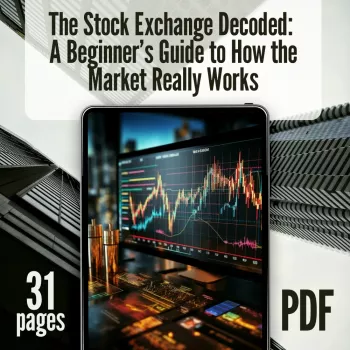
If the goal is to understand what’s actually happening behind the scenes (instead of memorizing buzzwords), The Stock Exchange Decoded: A Beginner’s Guide to How the Market Really Works (Digital Download) is built around practical clarity:
- Social Confidence in Any Situation | Printable Checklist (Digital Download)
- AI-Made Cozy Decor Mood Boards Checklist (Digital Download)
FAQ
Is the stock exchange the same thing as the stock market?
No. The stock market is the broader system of buyers, sellers, and trading venues, while a stock exchange is a specific regulated marketplace with listing standards and trading rules.
What’s the difference between a market order and a limit order?
A market order prioritizes speed and generally fills right away at available prices, which can be helpful in liquid stocks. A limit order prioritizes price control, but it may not execute if the market doesn’t reach your specified price—especially during volatile periods.
How long does a stock trade take to settle?
The execution can occur in moments, but settlement is the back-office transfer of cash and shares. In the U.S., settlement is commonly T+1 (trade date plus one business day), though timelines can vary by security and market.
Recommended for you


Stop Overspending: Simple Budget Reset That Sticks
May 29, 2026













Leave a comment